GitOps State Capture & CI-Enforced Secrets Control
Versioned, auditable infrastructure state for a mixed Windows/Linux fleet, protected by two independent secrets controls — pre-commit sanitization and a CI gate that blocks the merge. Zero credential exposure since deployment.
Situation
Configuration state for a four-node fleet lived only on the nodes themselves: no central capture, no change history, and no control preventing a credential from landing in version control. Losing a node meant rebuilding it from memory — an unbounded recovery time and an unauditable one.
Constraints: mixed operating systems (Windows and Linux), no budget for an enterprise backup product, GitHub free tier only, and a hard requirement that a credential can never be exposed even when the operator makes a mistake.
Task
- Capture every node's configuration and service state as code on a daily cadence, with a full audit trail.
- Sanitize secrets before commit and enforce the same rule in CI so nothing that slips the local filter can merge.
- Apply one policy across Windows and Linux with platform-native tooling.
- Deliver a tested rebuild path with a bounded recovery time objective.
Action
↓
Git Push → GitHub Actions CI Gate
↓ ↓
✅ Merge 🚫 Block + Alert
Defense in depth: the sanitizer strips secrets before commit, and the CI gate independently rejects anything that slips through.
- Linux collection (Nova, Mira, Orin). systemd user timers run a full state capture daily at 02:30 plus an hourly delta sync; Bash collectors gather system and service state.
- Windows collection (Jasper). PowerShell collectors capture OS, GPU, and service state via Task Scheduler on the same daily cadence — different tooling, identical policy.
- Pre-commit sanitization. Regex-based stripping of API keys, tokens, private keys, emails, and phone numbers on both platforms.
- CI secret-scanning gate. A GitHub Actions workflow scans every push against 11 secret patterns and a filename blocklist (
.env,auth-profiles.json) and blocks the merge on any match. - Segregated repository layout. Each node owns its directory, so a compromised or misbehaving node cannot overwrite another's state.
- Runbooks. Credential policy documentation, an incident-response runbook for a suspected leak, and a tested node-rebuild procedure.
Implementation
Linux Nodes (Nova/Mira/Orin)
lab-backup.sh— Collect system + OpenClaw statelab-sanitize.sh— Regex-based secret strippinglab-git-push.sh— Lightweight hourly syncinstall_timer.sh— systemd user timer setup- Daily full backup at 02:30 + hourly delta sync
Windows Node (Jasper)
LabBackup.ps1— Collect OS, GPU, OpenClaw stateSanitize.ps1— PowerShell secret strippingSetupScheduledTask.ps1— Task Scheduler setup- Daily backup at 02:30 AM
CI Gate
verify-no-secrets.yml— GitHub Actions workflow- 11 regex patterns (API keys, tokens, private keys, etc.)
- Filename blocklist (.env, auth-profiles.json)
Result
- Recovery: clone the repository, follow the runbook, and a node is rebuilt in 30 minutes — a bounded, tested RTO instead of an unknown.
- Security: zero credential exposures since deployment, with two independent controls between an operator mistake and the remote.
- Auditability: every configuration change across 4 nodes is tracked in Git with timestamps and diffs.
- Consistency: one policy enforced identically on Windows and Linux.
- Self-documenting: each capture includes system specs, services, and health data, so the repository doubles as live infrastructure documentation.
Lessons & Next Steps
- Defense in depth for secrets. One layer is not enough. The sanitizer catches known patterns locally; the CI gate catches anything that evolves past the local filter.
- Different tooling, one policy. PowerShell and Bash implementations look different but enforce identical capture and sanitization rules.
- Untested backups are not backups. The restore runbook is validated by actually rebuilding nodes from the repository.
- Git is a strong state store. Versioned, diffable, hosted off-site, and with CI hooks built in.
Next Steps
- Add automated restore testing (monthly dry-run rebuild)
- Expand to backup VM snapshots metadata from Proxmox
- Add Slack/Telegram notification on backup failure
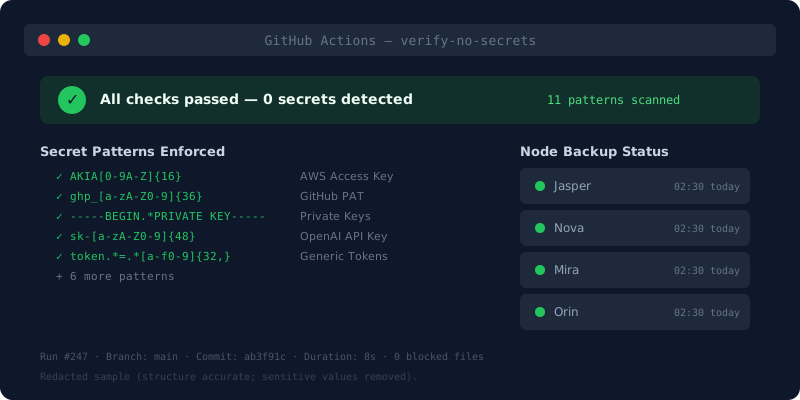
Redacted sample (structure accurate; sensitive values removed).
What to look at: Secret-scan CI gate with 11 pattern checks, per-node backup status with timestamps, and restore readiness indicator.
Evidence: Secret Scanning CI Gate (sanitized)
# .github/workflows/verify-no-secrets.yml (excerpt)
- name: Scan for secrets
  run: |
    PATTERNS=(
      'AKIA[0-9A-Z]{16}'           # AWS Access Key
      'ghp_[a-zA-Z0-9]{36}'        # GitHub PAT
      '-----BEGIN.*PRIVATE KEY-----' # Private keys
      'sk-[a-zA-Z0-9]{48}'         # OpenAI API key
      'token.*=.*[a-f0-9]{32,}'    # Generic tokens
    )
# 11 patterns total — blocks push on matchRelated artifacts: Proof Pack →