Cybersecurity Student · Homelab Builder · U.S. Army Veteran · Prior TS/SCI
Micheal Breedlove
I'm moving into cybersecurity from operations. To learn the work, I built and documented a self-hosted, segmented private cloud: SLO error budgets, automated incident response, CI-enforced secrets controls, and rehearsed disaster recovery.
- Role
- Cybersecurity student seeking entry-level SOC Analyst / Security Analyst / IT Operations roles
- Status
- Actively seeking entry-level roles · available to interview now · remote or Northern California
- Clearance
- Prior TS/SCI (U.S. Army; held during 35N Signals Intelligence Analyst training) — eligible for reinvestigation
- Credentials
- CompTIA Tech+ (2025) · CompTIA Security+ (in progress, 2026) · B.S. Cybersecurity & Information Assurance, WGU (in progress)
- Flagship
- Self-healing orchestration control plane for a four-node zero-trust private cloud — adaptive scheduling, distributed immutable state, approval-gated automation, validated DR

About
Career changer into cybersecurity who learns by building and documenting real systems.
I designed, secured, and operate a self-hosted private cloud lab on the patterns enterprise platform teams rely on: zero-trust segmented networking, configuration state captured as code, SLO-driven reliability, and automated recovery that is rehearsed on a schedule rather than assumed. My background is U.S. Army service (Unit Supply Specialist, 92Y; Signals Intelligence Analyst (35N) training, prior TS/SCI) and operations leadership in high-pressure environments. I am completing a B.S. in Cybersecurity & Information Assurance at WGU and the CompTIA Security+.
- Designed a self-healing orchestration control plane with health-aware adaptive scheduling across a four-node high-availability private cloud
- Built a database-free durable work queue on shared storage: idempotent dispatch, retry policy, stale-lease detection, and failure isolation
- Operate a Proxmox VE hypervisor cluster on ZFS copy-on-write storage with three-tier snapshot retention behind a dedicated OPNsense perimeter
- Engineered a zero-trust network: VLAN micro-segmentation, identity-based mesh overlay (Tailscale), SSH key-only access, and CI-enforced secret scanning — zero credential exposure
- Built an SRE practice for the lab: SLOs with error budgets, multi-window burn-rate alerting, automated incident lifecycle and postmortems, sandboxed disaster-recovery drills
- Use AI tools daily (Claude, Claude Code, ChatGPT; OpenClaw and Hermes agents on local LLMs) and built pressfarm.io, the ordering app used by two Michelin-starred restaurant kitchens (Next.js, TypeScript, Supabase)
- CompTIA Tech+ certified · Security+ in progress · B.S. Cybersecurity & Information Assurance, WGU (in progress) · prior TS/SCI, eligible for reinvestigation
Featured Project
AI Cluster Orchestration Platform
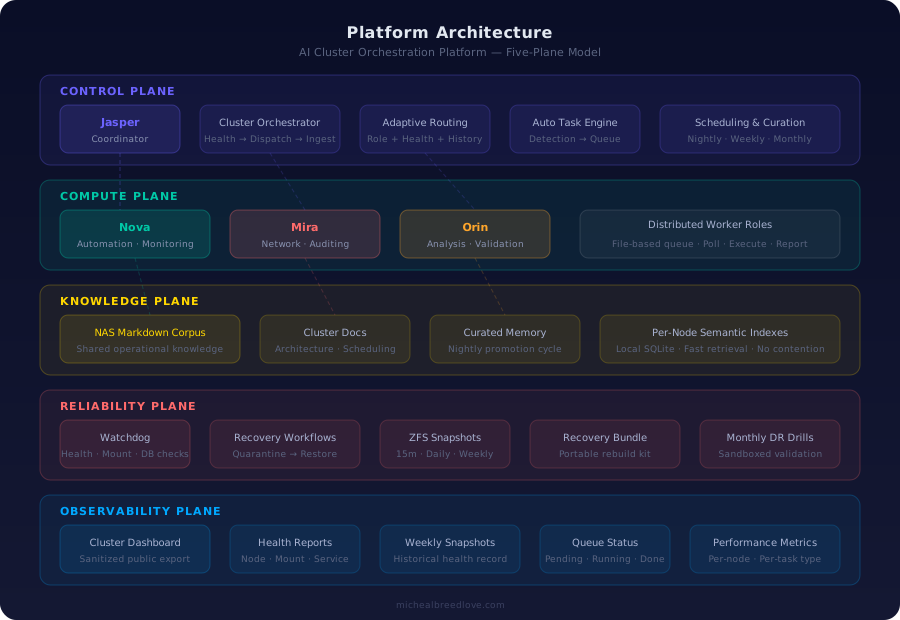
A self-healing control plane for a four-node high-availability private cloud: health-aware scheduling, distributed immutable state on snapshot-protected storage, automated recovery, and human approval gates on anything destructive.
The Jasper control node schedules health-aware jobs across the Nova, Mira, and Orin workers using role fitness, live health, and observed success rates. Durable operational state lives as plain-text records on snapshot-protected ZFS storage, and each node keeps a rebuildable local index — no shared database, no single point of failure.
Orchestrator · Inference
Automation · Monitoring
Network · Auditing
Analysis · Validation
Adaptive Routing
A health-aware scheduler scores every job against node health, role fitness, and observed success rate. Routing policy tunes itself as execution history accumulates — no manual rebalancing.
Distributed Immutable State
Operational knowledge is stored as versioned plain text on snapshot-protected storage, with nightly curation that promotes durable facts and archives noise. No shared database, no lock contention, no single point of failure.
Self-Healing
A runtime watchdog detects degradation, quarantines corrupt state, and restores from verified backups automatically. Preflight guards refuse to start on inconsistent state.
Disaster Recovery
A portable recovery bundle rebuilds the entire control plane on clean infrastructure. Monthly sandboxed DR drills prove the bundle restores without touching production state.
Autonomous Operations
A rule engine turns health signals into remediation tasks. Safe actions execute automatically; destructive or high-impact actions are held in an approval queue, bounding the blast radius of automation.
Durable Job Queue
Database-free work queue on shared storage with dispatch tracking, retry policy, stale-lease detection, and failure isolation. Crash recovery is a property of the design, not a bolt-on.
Selected Systems
Supporting projects with documentation, code, and case studies.
Engineering Capabilities
Core strengths demonstrated through working systems, not just theory.
Security Engineering
Zero-trust network design (VLAN micro-segmentation, identity-based mesh access), dedicated OPNsense perimeter, SSH key-only access, CI-enforced secret scanning, and audit-ready operational records.
Infrastructure as Code & Automation
Ansible, Proxmox VE, systemd and scheduled automation, GitHub Actions CI/CD, and GitOps workflows that keep configuration state versioned and reviewable.
Reliability Engineering
SLOs and error budgets, multi-window burn-rate alerting, automated incident lifecycle, safety gates, and recovery-first design validated by scheduled DR drills.
Distributed Systems
Multi-node orchestration, shared-nothing state architecture, database-free durable queues, and health-aware scheduling designed for partial failure.
AI-Assisted Operations
Self-hosted LLM inference with no external API dependency, rule-driven task generation behind human approval gates, and AI-orchestrated cluster maintenance.
Recovery & Resilience
ZFS snapshot tiers, self-healing watchdogs, portable recovery bundles, chaos experiments, DR drills, and conservative blast-radius policies.
Documentation Discipline
Automated knowledge curation, architecture documentation, operational runbooks, and explicit rollback procedures for every subsystem.
What This Demonstrates
These systems show how I approach production infrastructure: design for partial failure, automate recovery and rehearse it, measure reliability with SLOs, segment by default, keep secrets out of version control, and leave an audit trail. The footprint is a four-node private cloud; the patterns are the ones enterprise platform teams run at any scale.